Packaging plays an essential role in the food industry. It protects products during transport, preserves their freshness and extends their shelf life, helping to reduce food waste. However, most of the packaging used, such as plastics, is still derived from fossil fuels, which complicates its end-of-life management and causes a negative environmental impact.
What if we changed the end of the story? Packaging does not have to become waste; it can form part of a circular value chain in which renewable, bio-based resources are transformed into packaging which, once it has served its purpose, returns safely to the environment.
Renewable, bio-based resources
Every harvest generates a quantity of biomass that is often under-utilised. Berry crop residues, pruning waste and other agri-food by-products contain natural compounds that can be converted into the basic components of packaging materials.
We focus on developing materials that accompany food from the field to the home. In the previous article, we looked at how biodegradable mulch films affect berry cultivation and now we’re focusing on the next step: the packaging of those berries so they reach our homes.
By processing berry crop residues and pruning waste in a biorefinery, we recover valuable components such as cellulose, lignin and furfural, which we aim to convert into bio-based polymers using mechanochemistry and white biotechnology. With these polymers, we will be able to develop bio-based packaging capable of protecting food and helping to preserve it.
Furthermore, by incorporating naturally derived active ingredients with antimicrobial properties, the project aims to improve product quality and extend the shelf life of fresh produce. This reduces reliance on fossil-based plastics and also helps to reduce food losses throughout the supply chain.
Let’s try to visualise it:
- Waste from berry cultivation is turned into valuable raw materials
- These are transformed into bio-based polymers
- The polymers are turned into food packaging
- At the end of their useful life, the materials are reused, recycled or biodegrade, returning resources to the soil that will give rise to new crops, new waste and new materials.
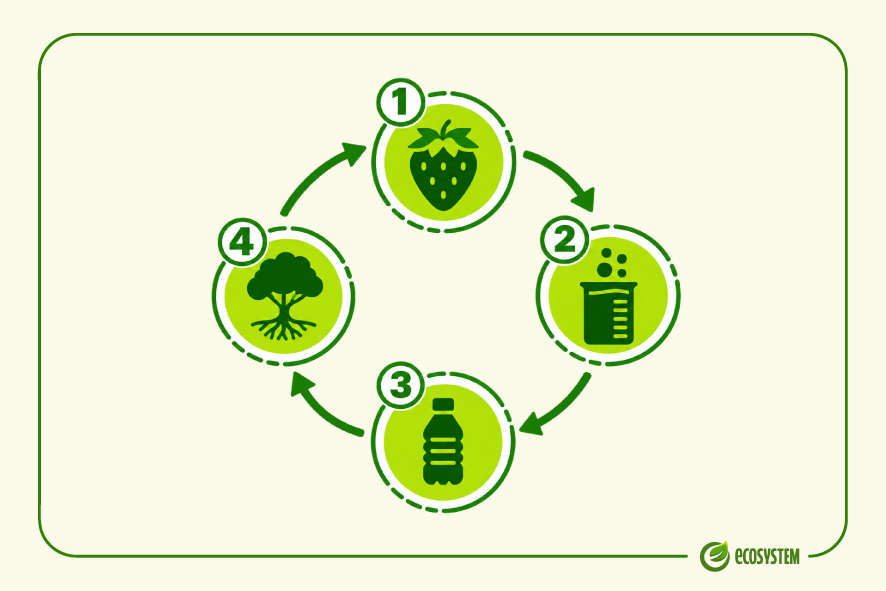
In short, ECOSYSTEM is working on the development of bio-based mulch films and packaging which, once they have served their purpose, degrade to nourish the soil from which they originated. A cycle in which the waste from one harvest becomes the starting point for the next.